My sister and I had the opportunity to experience the Mary Cassatt exhibit at the Philadelphia Museum of Art. This is an artist I have studied in multiple art history classes at Marywood University, especially since she is one of those few women art…
My sister and I had the opportunity to experience the Mary Cassatt exhibit at the Philadelphia Museum of Art. This is an artist I have studied in multiple art history classes at Marywood University, especially since she is one of those few women artists that America is willing to boast of and from one of the more popular art styles in the modern era. She is a captivating historical figure and there were many things I was impressed by in this Impressionist's work, but none more so than the display of two works of the same figure.
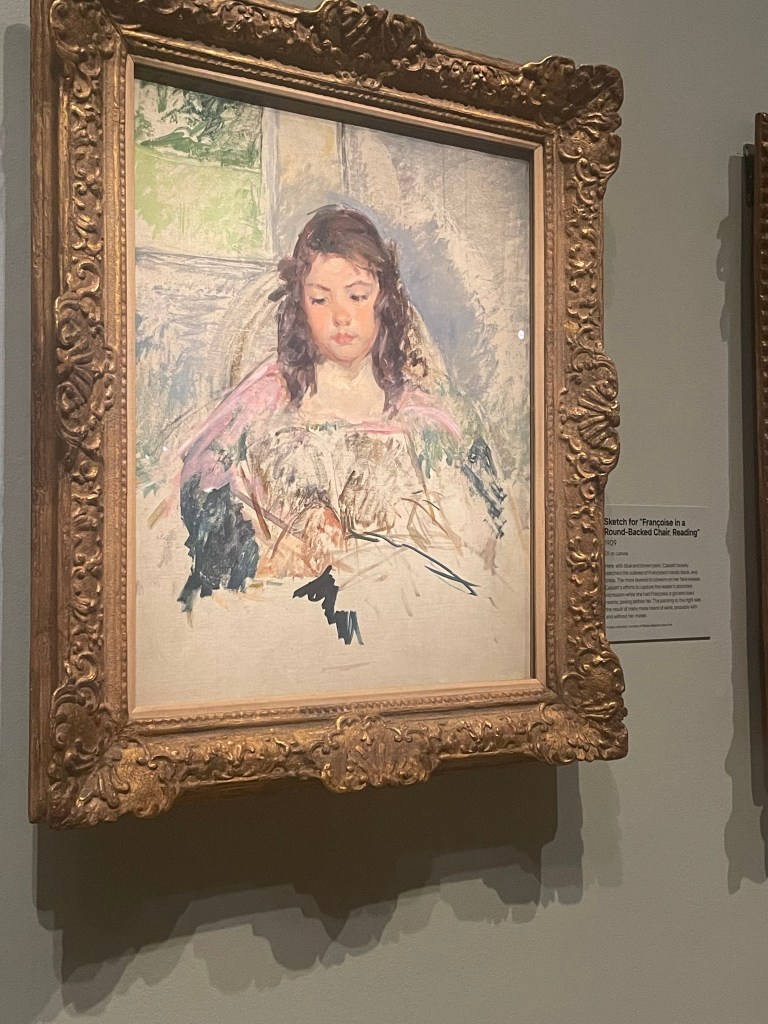
Hung side by side in gilded frames, portraits of Françoise in a Round-Backed Chair, Reading (1909) seem to talk to each other from their places on the wall. These artworks aren't sentient of course, a painting is just an object after all. Yet by them being next to one another, they are in dialogue, one the viewer is trying desperately to listen in on.
Depicted in both works is a young girl sat in the interior of a home, her features betraying just how absorbed she is in the books she is reading. In the final oil painting, the deep blue and rigidity of the book strike a sharp contrast to the soft pink of the girl's dress, the weight of the book evident in the how it rests in the tensed fingers of Françoise. It is a lovely piece and is lovingly rendered, Cassatt taking careful pains to replicate the expression of quiet absorption that fascinates us now a century later. A figure is presented but her mind is elsewhere, somewhere the viewer can't go, and all we are left to do is marvel at the beauty of that amount of focus. However, it all feels slightly too formal, too posed. Why?
Often in art, we believe that the sketch is an "inferior" form of the finalized version of itself, something merely to be used as prep work, a draft. However it is this sketched oil painting by Cassatt that does the sitter and the act of reading justice, far more so than any adherence to observational reality. I believe it is because in the sketch, we actually get to see the feeling of what being absorbed is like. In the sketch of Françoise, the world is abstracted, a frenzied blur of brushstrokes that construct a world like the reader does in her head as she reads along. While only one of these pieces boasts the artist's signature, it is the sketch that truly shows creative authorship.
However, one couldn't be fully understood without the other. Viewing these two pieces together feels like getting to witness curiosity and discovery in action. The more fully rendered viewing of the outside world, the one we see of Françoise opening her book, is curiosity, the viewer judging the cover or the reality. In the sketch, Françoise and the viewer get to discover and delve deeper than the surface level of the canvas. The pieces need each other in order for us to visually connect them, which allows us to permeate that same surface level of seeing the works into actually experiencing them.
If you would like to learn more about Mary Cassatt and her work, I recommend clicking the links down below! She is a fascinating figure that will benefit you from further research:





No comments:
Post a Comment