Unlike humans, who usually experience heat waves only in the summer, marine life can find itself in hot water, or marine heat waves, throughout the year. While the topic is well-researched in the world's oceans, little is known at a smaller scale.
The Virginia Institute of Marine Science wrangled 35 years of data to release the first study that analyzes marine heat waves below the first meter of water in an estuary, especially in the Chesapeake Bay. The study found that marine heat waves have seasonal patterns, which could lead to a habitat squeeze for fish and disrupt blue crab migration patterns.

A study from the Virginia Institute of Marine Science shows that blue crabs might change their migration patterns as water temperature increases before and after marine heat waves
"The only reason that we are able to do [that kind of study] is because of all of the monitoring programs in the Chesapeake Bay," said Nathan Shunk, who is the lead author of the study. "Everybody really cares about the health of the Bay."
Marine heat waves occur when water temperatures are warmer than 90% of previous observations for a particular location and time of year. They last 11 days on average in the Bay and can happen throughout the year. Wind, warm water from rivers, ocean currents and a warming atmosphere are all factors that cause this phenomenon.
According to the National Oceanic and Atmospheric Association, the world's oceans absorb 90% of the excess heat associated with global warming. In turn, marine heat waves are becoming warmer.
However, scientists in the field emphasize that marine heat waves are not so frequent and intense that oceans will be caught in a perpetual heat wave. Instead, a warming planet calls for a new definition of "normal conditions" and new thresholds that define heat waves.
"In reality, the impacts associated with global warming, which is a slowly evolving warming of the ocean, are going to be different than the impacts associated with short duration, high-intensity episodic events like marine heat waves," said Dillon Amaya, research scientist at the NOAA Physical Sciences Laboratory.
Certain studies, like the VIMS research, use a shifting baseline that accounts for ocean warming. That way, marine heat waves remain defined as exceptional and brief events.
The study found that the heat waves in the Bay show seasonal patterns. During the fall and winter, the phenomenon occurs throughout the water's layers. Increased temperature means there's less oxygen in the water. The study showed that the biggest decrease in dissolved oxygen took place in the winter and early spring.
"It would probably be more like going to a higher elevation," Shunk said. "There's less oxygen in the water, but it's nowhere near lethal levels."
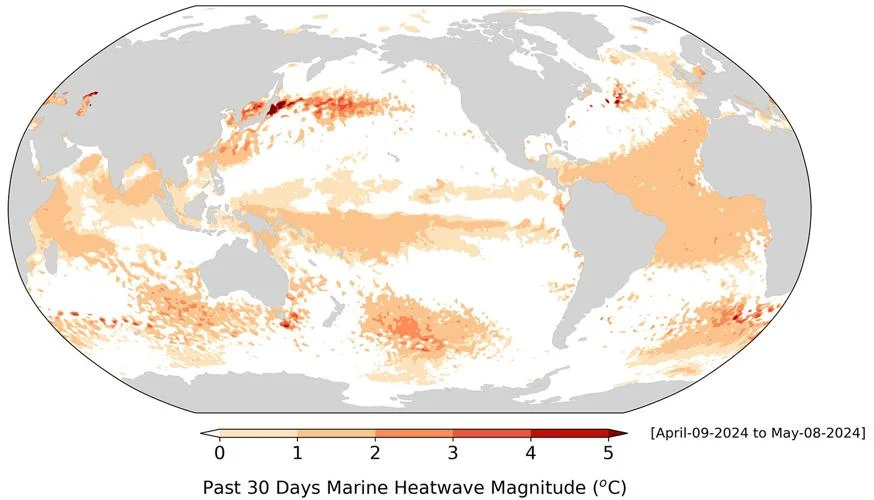
This map shows the magnitude of marine heat waves in the world's oceans over a 30-day period from April 9 to May 8, 2024. (
During spring and summer, the water density was different throughout the Bay's layers, meaning heat waves only occurred near the surface at a depth of 5–10 meters. Flows from freshwater in rivers that merge into the Bay reach their peak in spring. Heavier saltwater falls to the bottom as lighter freshwater sits on top, trapping the heat because it can't sink to deeper levels.
The change in dissolved oxygen from the heat waves wasn't as large in spring and summer as it was in fall and winter. But dissolved oxygen levels are already low in the summer because of hypoxic areas or "dead zones," where the oxygen is depleted by decaying algae blooms.
"That's because, on the edges of the border of the hypoxic region, the dissolved oxygen is so low that just small changes kind of push it into levels that are potentially lethal for fishes and whatnot," Shunk said.
With the heat trapped at the top water layer, fish must swim lower. But hypoxic zones near the bottom limit where fish can escape.
Aquatic species are affected by marine heat waves differently. Some can easily recover from short periods of intense heat but die from constant heat exposure. Others can adapt to slowly increasing temperatures but die from heat shock. Some organisms move to a different area, while others can't.
The study suggests that marine heat waves could change the migration patterns of blue crabs. Rom Lipcius, professor of marine science at VIMS, said blue crabs have naturally evolved to thrive in warm temperatures as a tropical marine species. But he also said that timing is everything. He has seen blue crabs' reproduction season start earlier when the water gets warmer, and marine heat waves could be a mechanism pushing that.
Female blue crabs in the Bay molt and mate starting in spring. Then, in late summer and fall, they migrate south to hatch their eggs near the mouth of the Bay. Lipcius pointed out that factors associated with heat waves, like hypoxic zones, could push blue crabs to the shallows or delay females from returning south to hatch their eggs. This could mean fewer crabs to harvest.
Heat waves can also be fatal to crabs that get caught in crab pots and can't escape to cooler water. If crabbers knew when a marine heat wave was coming, they could put traps in the shallows or temporarily stop operations to avoid harvesting dead crabs.
"If you want to predict what's going to happen, you have to have a very good understanding of the mechanisms in which [marine heat waves] are generated and their behavior in the ocean, or estuary in our case," said Assistant Professor Piero Mazzini, who supervised the study.
Shunk and Mazzini hope future studies look at what specifically triggers marine heat waves in the Bay and compare marine heat waves in different estuaries.


No comments:
Post a Comment